Experience

What depth feels like.

VuCalendar starts as a clear planning surface. This page follows what happens when the work gains layers: context, variation, reflection, and continuation.

Experience moments, one by one

Experience path

Follow the work as it gains layers.

01

Find

Find what you already placed

When the work is already somewhere in your plan, the experience should return you to its real position rather than pull you into a separate search result.

01 · LocalVuSearchVuFind anything, from any view.
LocalVu

SearchVu

Find anything, from any view.

Already freesearch within TaskHub

Every user gets search inside TaskHub. SearchVu extends it into your calendar — DayVu, WkVu, and MnthVu. Type a query and the calendar filters in place: matching tasks stay in their scheduled positions while the rest fade. The day structure stays intact, so you see where a task lives, not just that it exists. Search by title, notes, group, or time-of-day. Results update live; clear it and everything returns.

How it plays out
In practice

You're planning next week in WkVu and need everything tagged “pantry.” Type it — three matching tasks light up across Wednesday and Friday in their real time slots. No screen-switching, no lost context.

Before

Search only works in TaskHub. Find it there, note the date, navigate back to the calendar.

With it

Search straight from any calendar view. Matches appear in place. Structure preserved.
Free in TaskHub · SearchVu extends it into Day / Week / Month
NextCarry
02

Carry

Keep the context with the work

Some tasks need more than a title. The page starts showing how VuCalendar keeps supporting material and procedure inside the thing you are actually doing.

01 · LocalVuFile ArtifactsThe task becomes everything related to the work.
LocalVu

File Artifacts

The task becomes everything related to the work.

Already freelink & YouTube attachments

The Artifacts section lives inside VuModal. Links and YouTube are always free. File Artifacts unlocks the rest: photos and videos from your library, and documents from the Files app — PDFs, images, anything iCloud, Drive, or Dropbox holds. Each saved item renders with purpose-built UI: a YouTube player, a tappable photo gallery, file cards with type badges. One task can carry mixed types together, and everything is device-local — offline-ready and persistent through edits, date changes, and lifecycle events.

How it plays out
In practice

You finally want to make your mom's lasagna. She texts a photo of her handwritten recipe card; you share it into VuCalendar, pull it into the “Make mom's lasagna” task, paste a YouTube link for the pasta technique, and attach the cookbook PDF. Sunday in the kitchen, it's all in one place — no phone-juggling.

Before

Task here. PDF in email. Photo in your camera roll. Link in Notes. You remember, hunt, switch.

With it

All attached at the task. Mixed types together. One tap to open. Available offline.

Links & YouTube free · files unlock with File Artifacts
02 · LocalVuMulti-RegimentOne task. Multiple focused lists.
LocalVu

Multi-Regiment

One task. Multiple focused lists.

Already freeone regiment list per task

Every task carries a regiment — a step-by-step procedure you work through. The free tier gives you one list per task. Multi-Regiment unlocks multiple named lists on the same task. In VuModal they appear as tabs; in a task's expansion you cycle through them with ‹ › arrows, one focused list at a time. Each list is self-contained, so “prep step 1” never blurs into “execute step 2.” All lists save as one unit and survive edits, cycling, and archiving.

How it plays out
In practice

You're hosting Thanksgiving for the first time. One task — “Thanksgiving dinner” — carries four regiments instead of one anxious list: Shopping, Day-before prep, Day-of timing, and Cleanup. You reference one focused list at a time, no overwhelm.

Before

One list per task. Cram 30 mixed-phase steps in, or split into separate tasks and lose the unity.

With it

Multiple named lists on one task. Cycle with ‹ ›. One focused phase at a time.

Multiple named lists on one task · cycle with ‹ ›
NextShape
03

Shape

Shape related work before it scatters

When several tasks belong to one effort, the experience becomes an authoring surface instead of a repeated save-and-reopen loop.

01 · LocalVuBulk SetsA batch-authoring canvas for related work.
LocalVu

Bulk Sets

A batch-authoring canvas for related work.

Already freeup to 2 Bulk Sets

A Bulk Set is a named container for staging multiple related tasks together before you commit them. Open BulkSetModal, add task cards one at a time, and configure each with its own full setup — time-of-day, duration, title, regiment, artifacts. The free tier gives you 2 Bulk Sets; the unlock removes the cap. Unlike Groups (persistent categories that color-cascade across your whole calendar), Bulk Sets are temporary authoring surfaces — a place to plan a batch of related work in one session.

How it plays out
In practice

You decide to plant a tulip garden. You name a Bulk Set “Tulip planting” and stage cards: soil prep (Early Day, 90m), bulb planting (Mid Day, 120m), mulching (Late Day, 45m), first watering (a Todo). One save commits all four as live tasks.

Before

Create a task, save, reopen the editor, create another, save… lose your flow each time.

With it

Stage every related card in one editor, configure each fully, save the whole batch at once.

Stage related tasks 1·2·3·4 · save the whole batch at once
NextAdapt
04

Adapt

Adjust the plan as reality changes

A day changes. A task takes longer. Work happened yesterday. These moments need structure that can bend without losing the original task.

01 · ProVuCalendar OverrideSame task, different shape per day.
ProVu

Calendar Override

Same task, different shape per day.

Already free5 tasks with overrides

A task doesn't always take the same time or land in the same part of your day. Calendar Override adds a drawer where you customize any date's Time of Day, Sub-time, and Duration independently — without changing the task's base definition. Select a date chip, adjust what's different, save. Dates without overrides use the base schedule. One identity, one color, one mode — the schedule adapts per date. Free for your first 5 tasks; unlimited with ProVu.

How it plays out
In practice

Your “Daily Standup” is normally 30 minutes in Early Day. Thursday's runs 45 and moves to Late Day for a retro. Open the drawer, tap Thursday, switch the lane, bump the duration. Friday goes back to normal automatically.

Before

Make separate tasks for each variation, or live with one rigid schedule that ignores real life.

With it

One task, per-date overrides for time, slot, and duration. The base schedule stays intact.

Override one date’s lane, sub-time or duration · the base schedule stays intact
02 · ProVuBackdate PlanningSchedule into the past you actually lived.
ProVu

Backdate Planning

Schedule into the past you actually lived.

By default the date picker only offers today and forward. Backdate Planning unlocks past dates — yesterday, last week, last year. Past dates show in amber to distinguish them from future green, and you can mix freely on one task. Once saved, backdated tasks appear at those past positions, can be completed or logged retroactively, and feed HistoryVu's pattern analysis. Notifications don't fire for the past — it's already happened.

How it plays out
In practice

You spent two weeks renovating your kitchen but never logged it. Make a task, swipe back two weeks, tap-select the eleven days you actually worked — amber for past, green for today. Now your history reflects what really happened.

Before

Picker locked to today forward. Forgotten work stays a gap you can’t fill.

With it

Past dates unlocked and colour-coded. Capture what already happened; mix past and future freely.

Past dates in amber · future in green · mix freely on one task
03 · ProVuOvertime Resolution AssistanceYour planning co-pilot when lanes are full.
ProVu

Overtime Resolution Assistance

Your planning co-pilot when lanes are full.

Already freealways-on overload warnings

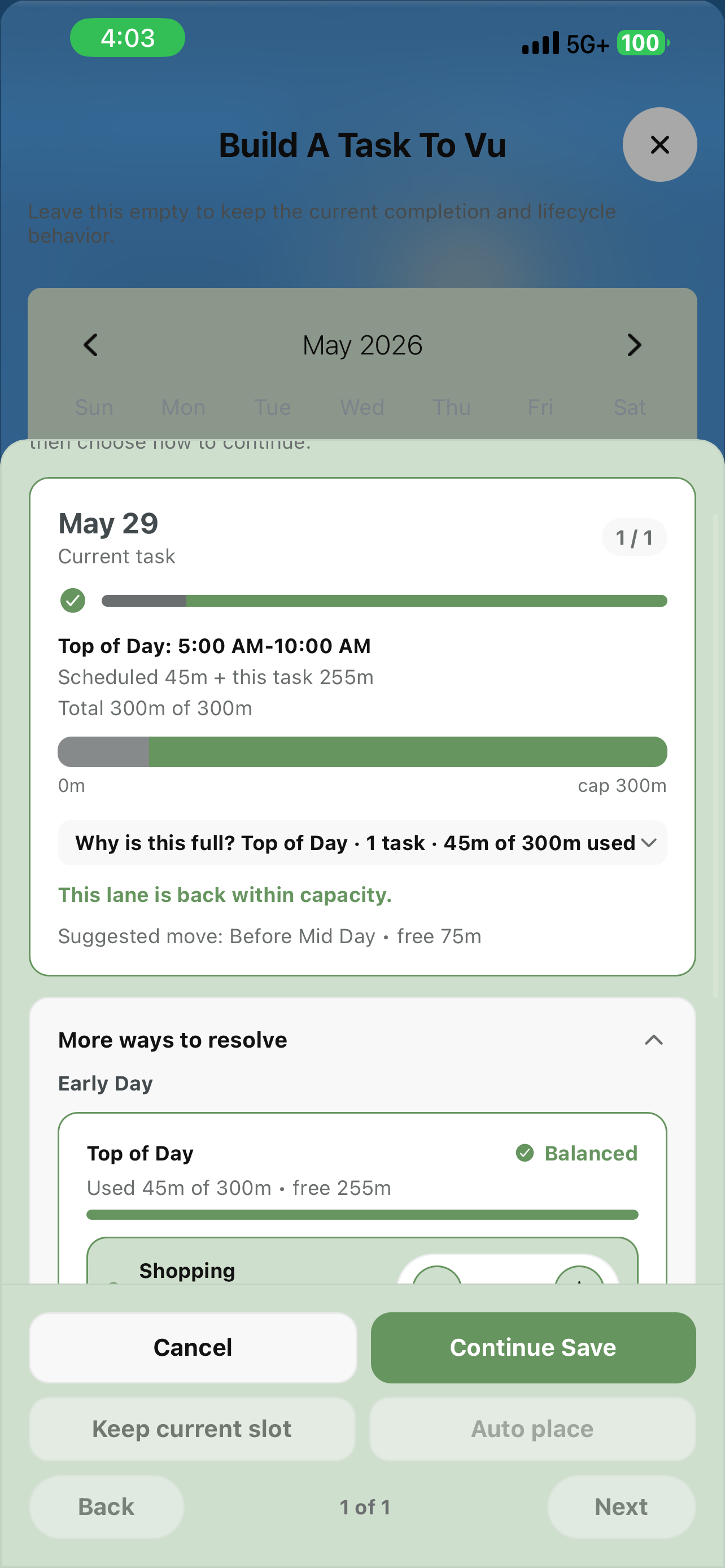
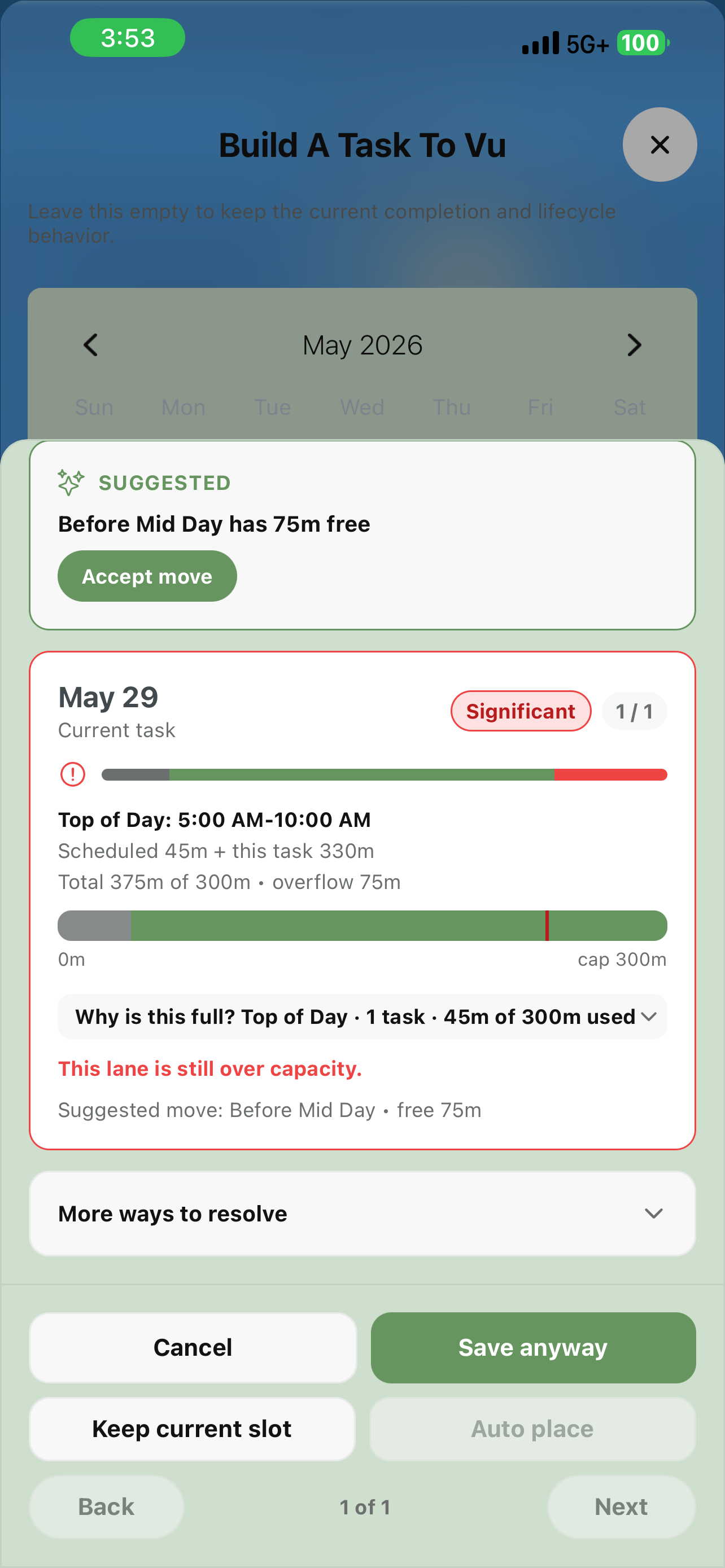
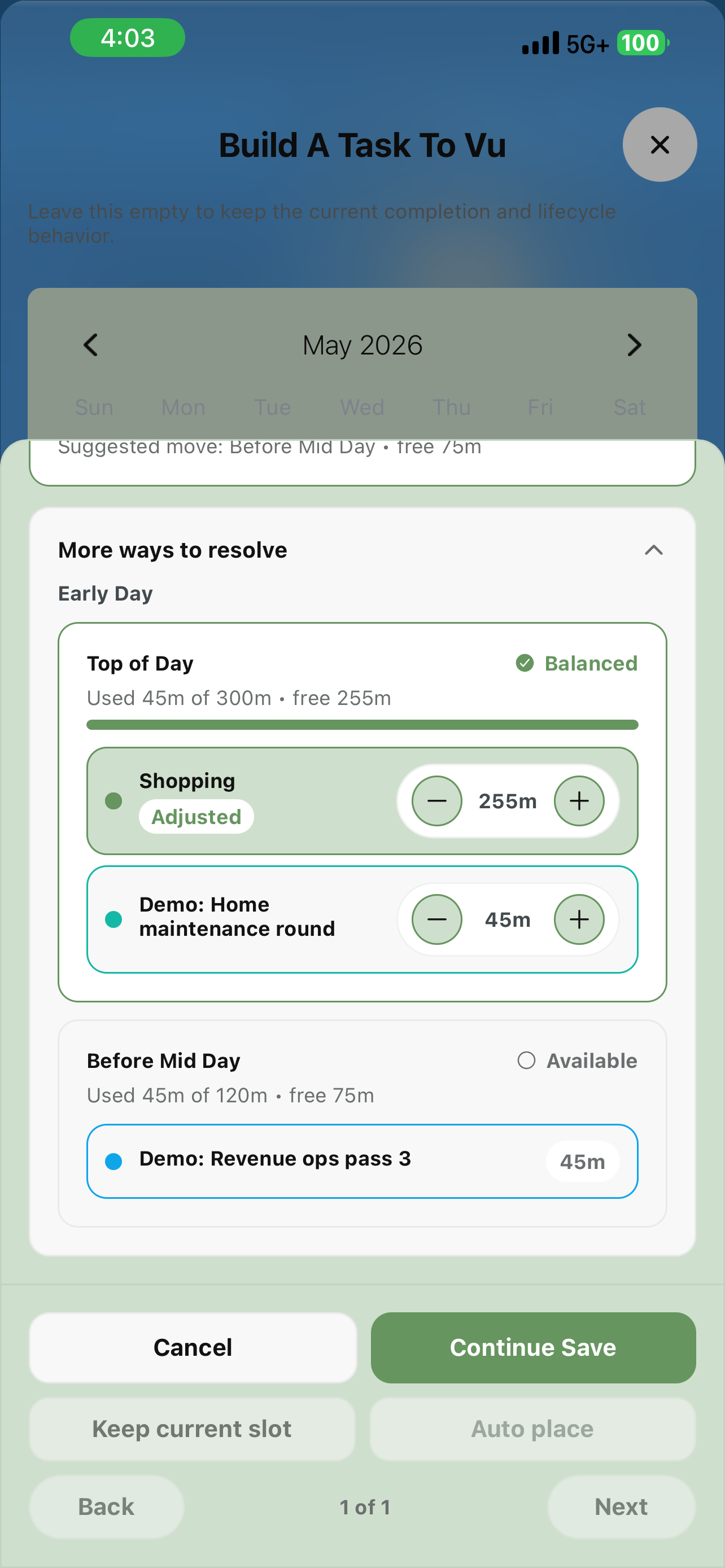
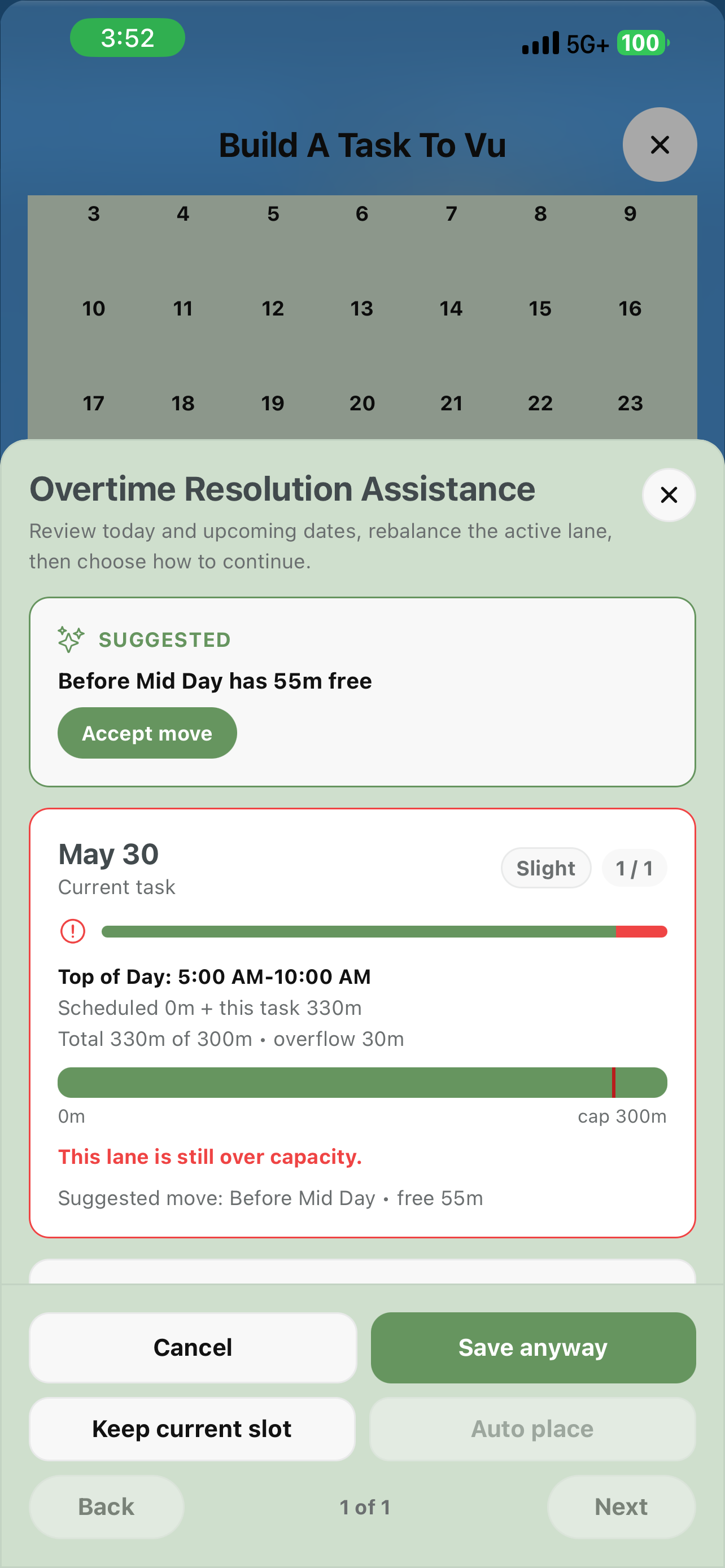
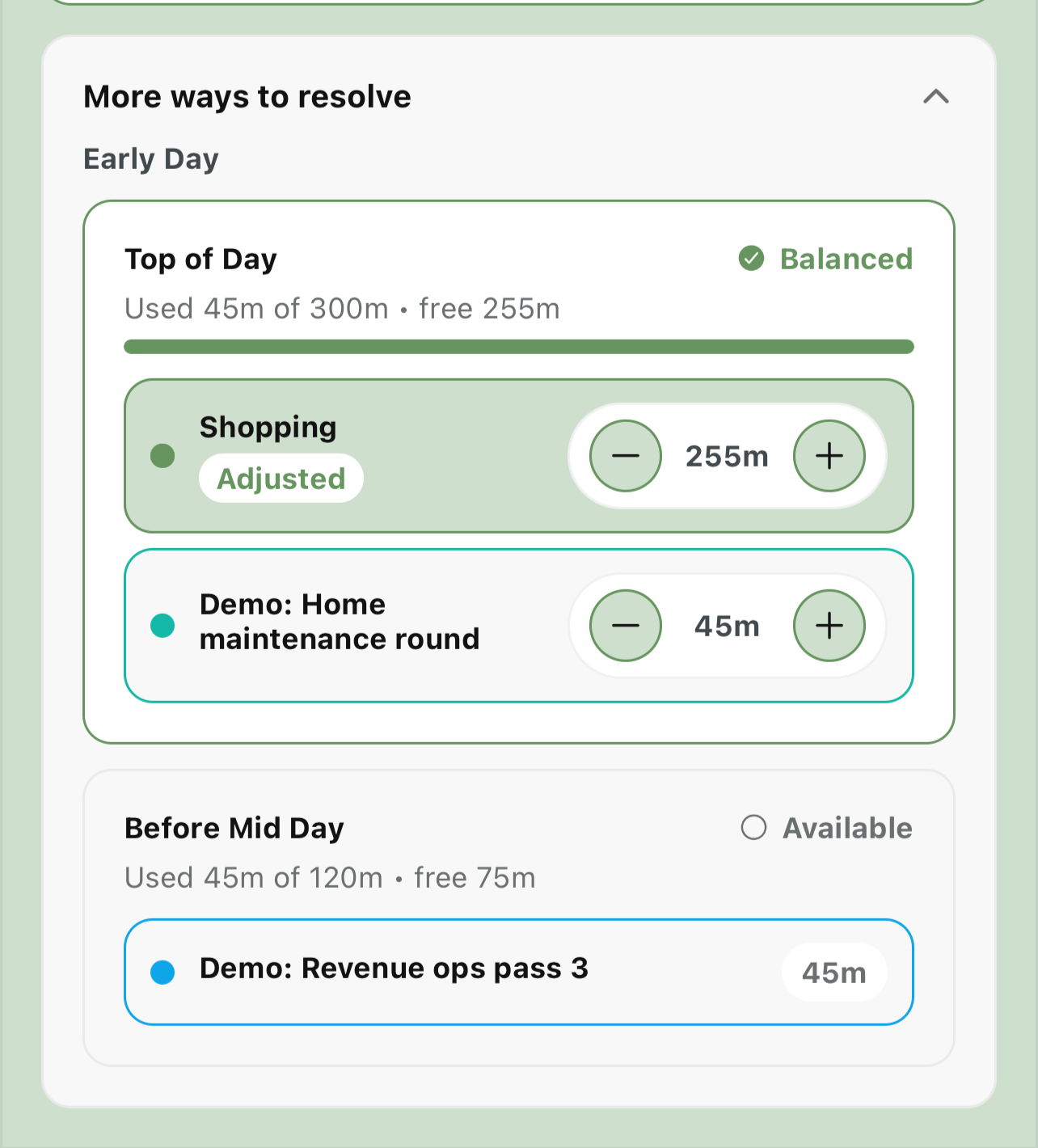
Free users always see when a lane is overloaded. Overtime Resolution lets you act on it in place: it intercepts the save and opens a rebalancing modal that calculates to the minute. A SUGGESTED card recommends the lightest open sub-block; “More ways to resolve” reveals per-task duration adjusters that update the capacity bar live. Auto place goes further — it quietly evaluates each overflowing lane before the modal even opens and resolves clean fits silently, never trimming a task or creating a new overflow.

How it plays out
In practice

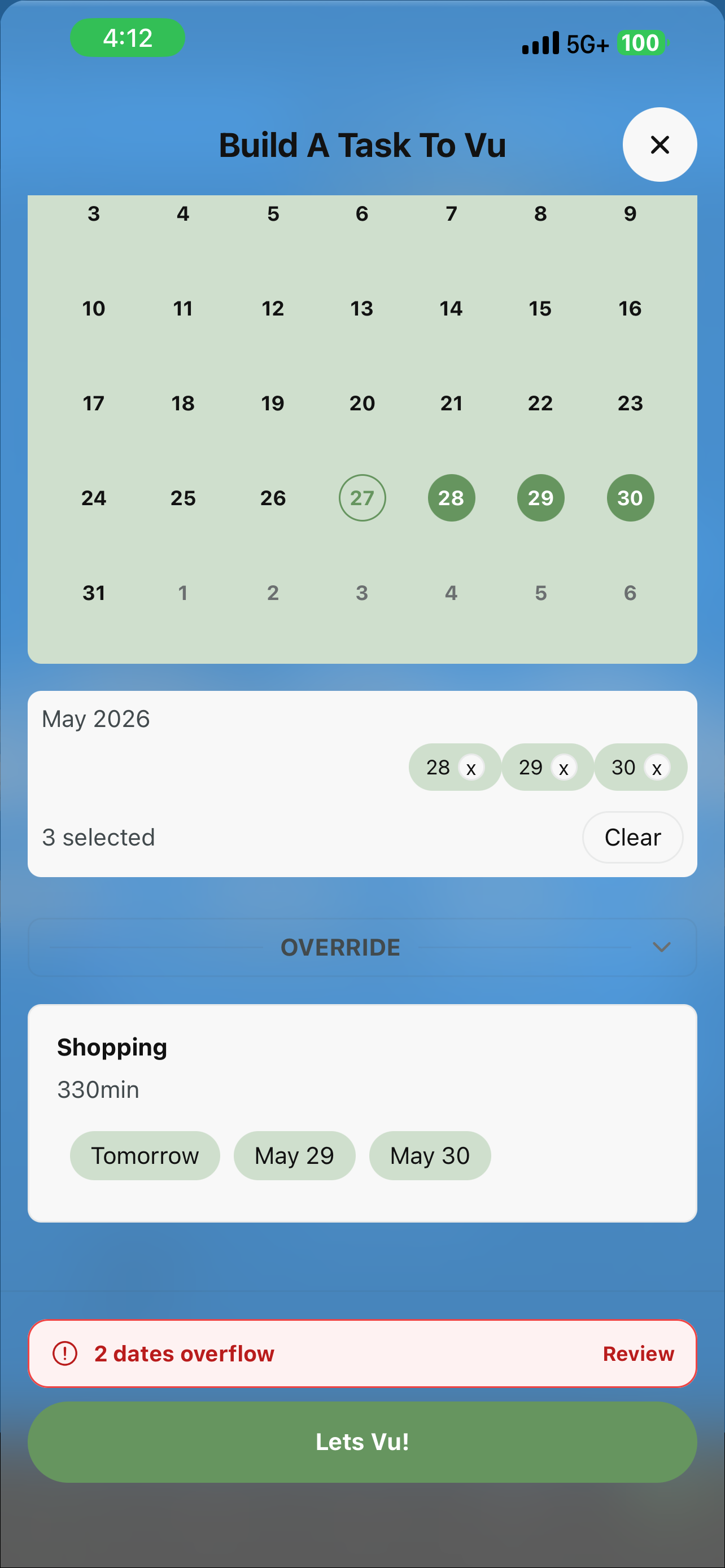
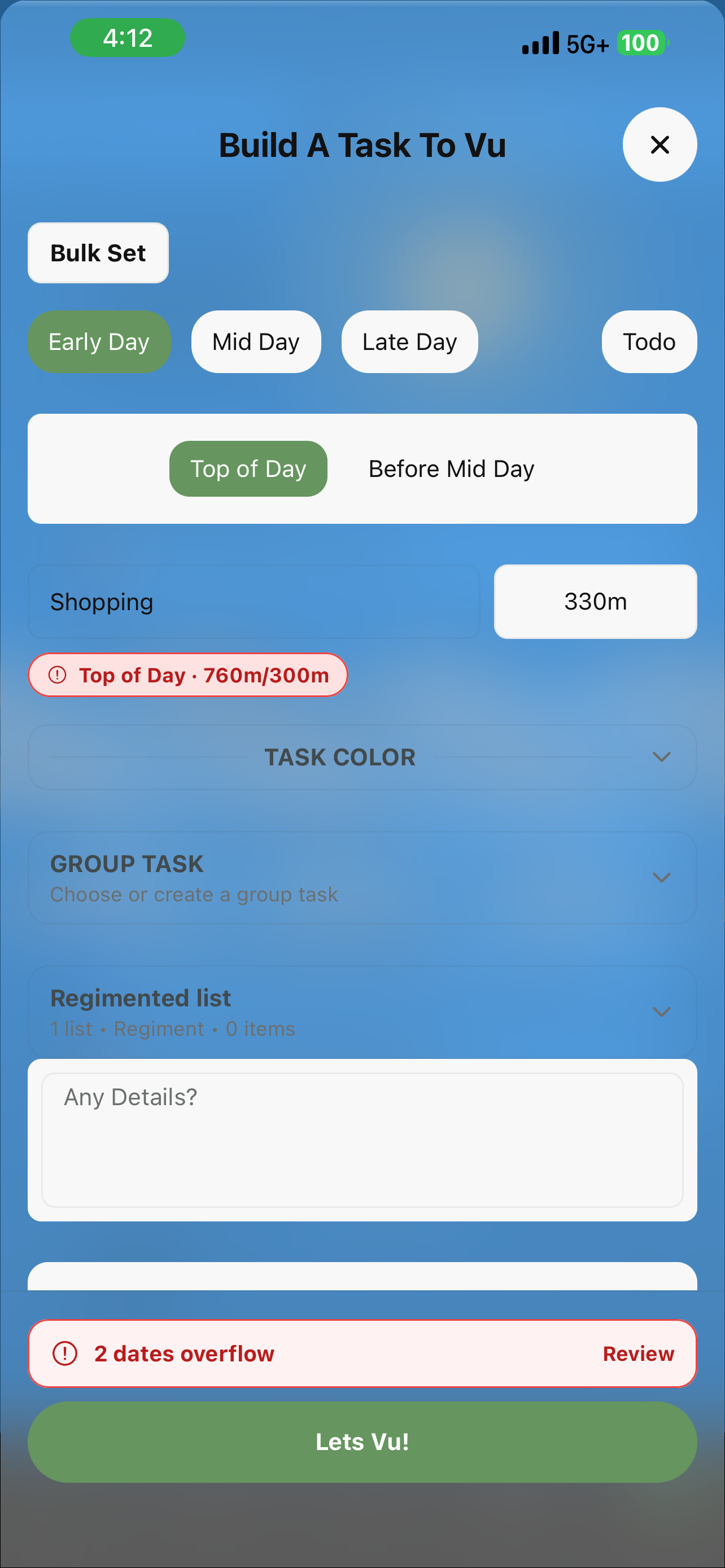
You schedule “Shopping” at 330m into Top of Day, which holds 300m and already has 45m. The modal opens: overflow 75m, “Significant.” It suggests Before Mid Day (75m free). Tap “Accept move” — or trim Shopping to 255m with the adjuster. The bar turns green. Continue Save.

Before

A warning chip, then you save anyway and figure it out later — or cancel and rearrange by hand.

With it

A rebalancing modal with exact minute math, a suggested fix, live adjusters, and Auto place.

NextReflect
05

Reflect

Reflect, continue, and clean up

Depth is not only more controls. It is the ability to understand what happened, keep a completed round, and manage many tasks without breaking the system into fragments.

01 · ProVuHistoryVuNot a report. A mirror.
ProVu

HistoryVu

Not a report. A mirror.

HistoryVu is month-grouped reflection with two lenses. Reflective shows what you've actually been doing — weekly and monthly review by group, bulk set, and time-of-day. Diagnostic detects patterns: where tasks slip, which slots overload, which groups stall. Scroll-tracked rings, narrative headlines, and mode-aware lenses make it genuinely introspective — it counts presence, not absence, and never scores you. The headline reason ProVu exists.

How it plays out
In practice

After a steady month, HistoryVu reflects that Early Day held the clearest planning rhythm, Practice tasks logged at 92%, and your “Creative” group stalled every Friday afternoon — a pattern you'd never have spotted by memory.

Before

No historical lens. You remember what you think you did.

With it

Reflective + diagnostic reading of your real rhythm. Patterns you couldn’t see by hand.

HistoryVu · this week
78%
Completion
64%
Practice
91%
Followed
“Early Day held the clearest planning rhythm this week.”
02 · ProVuCycleFinish a round. Keep it. Start the next.
ProVu

Cycle

Finish a round. Keep it. Start the next.

Some work runs in rounds. An eight-week training block, a school term, a growing season. When a round ends you want to keep what actually happened, and you don't want to retype everything to begin again.

Cycle does both in one tap. Everything from the round you just finished, the dates, notes, files and checklists, is saved into a permanent record you can always look back at. Then the same task comes back to you empty and ready, so you can pick new dates for the next round.

It stays the same task the whole way through: same name, same colour, same group, same mode. A small number beside the symbol counts how many rounds you've done. Nothing is duplicated, nothing is thrown away, and the app never does this by itself. You decide when a round is over.

How it plays out
In practice

Your eight-week training block ends. You tap the cycle symbol. Weeks 1 to 8 freeze into a record you can always revisit, the little counter ticks over to 2, and the same task comes back empty so you can set the dates for weeks 9 to 16.

Before

Archive it and build the next one from scratch. The finished round is gone, and you retype work you already did.

With it

One tap. The finished round is kept for good, and the same task is ready for new dates.

This is the cycle symbol.Wherever it appears, on a task card in TaskHub, on a “Ready to cycle” notice, or on an archived task like this one, tapping it does the same one thing: close this round, keep it, and start the next.
03 · ProVuIntent Without A CeilingIntent on everything you run.
ProVuCapability · Unlimited Tracking Modes

Intent Without A Ceiling

Intent on everything you run.

Already freeup to 20 active tracked tasks

Tracking mode — Completion, Practice, or Guide — is the app's intent layer, and it's free to experience on up to 20 active tracked tasks at a time. ProVu lifts the cap so every task you run can carry intent, with no ceiling. Existing assignments are never stripped if you lapse; the cap only limits creating new ones beyond the free allowance. The mode you set still drives action labels, lifecycle, reminders, and how HistoryVu reads the work.

How it plays out
In practice

You lean hard on Practice and Guide across dozens of ongoing routines and stewardship tasks. Past 20 active, ProVu keeps every one of them tracked — and feeds a richer HistoryVu in return.

Before

Twenty active tracked tasks is plenty to feel the concept — but heavy users hit the ceiling.

With it

No ceiling. Tag intent on everything; the sensor feeds the reflection.

VuModal · intent
Complete · Completion — finishable work
Log · Practice — consistency
Follow through · Guide — stewardship
Free for 20 active · unlimited with ProVu
04 · ProVuMulti-AdjustBatch actions. Staged precision.
ProVu

Multi-Adjust

Batch actions. Staged precision.

Without it, reorganizing means one task at a time. Multi-Adjust lets you perform the same operation on many tasks at once from TaskHub — delete, archive, move to group, assign to bulk set, or remove. Enable it per bucket, select your tasks, and stage the action; queued operations show counter badges until you confirm. Every batch is atomic — all of them, or none.

How it plays out
In practice

End of the month: 12 completed tasks to archive and 5 to reassign to a new group. Two batch actions instead of seventeen individual edits.

Before

Select → act → repeat, for every task. Management friction blocks organization.

With it

Select many → one batch action → confirm. Staged counters, atomic execution.

Stage delete / archive / move across many tasks · one atomic batch
NextPersonalize
06

Personalize

Make the planning surface feel like yours

The environment around the work matters too. Personal Library is the part of the experience where the planning surface can carry your own visual world.

01 · LocalVuPersonal LibraryYour photos. Your planning backdrop.
LocalVu

Personal Library

Your photos. Your planning backdrop.

Already freeweather sky + 1 curated collection

Set up to three of your own photos as calendar backgrounds — a sunset you took, a place you'd rather be while you plan. Choose how they rotate: Manual, Daily, or Time-of-Day, sequential or random. Images are copied into the app so they survive updates and never link back to your camera roll. The same Motion and Intensity controls apply: above Off, a slow Ken Burns pan keeps the still alive; at Cinematic, a breathing vignette frames the edges.

How it plays out
In practice

A golden-hour ridge line from a hike last fall, a beach sunrise, a quiet bookstore corner. Set rotation to Time-of-Day, sequential — morning planning happens against the sunrise, evening against the ridge line. The backdrop becomes part of the ritual.

Before

App gradients and weather scenes. Beautiful, but not yours. Your photos sit unused.

With it

Up to three personal photos. Manual / Daily / TOD rotation. Ken Burns motion. All your aesthetic.

Up to 3 photos · slow Ken Burns motion at higher intensity
NextDirection

Direction

Where the experience is heading

The next layer brings existing calendar commitments into the same planning view, so tasks and outside events can be read together.

In developmentCalendar ImportYour existing calendar, inside VuCalendar.

Ready to add depth?

Features explains the foundation. Pricing explains access. Experience shows what changes once the work carries more context.